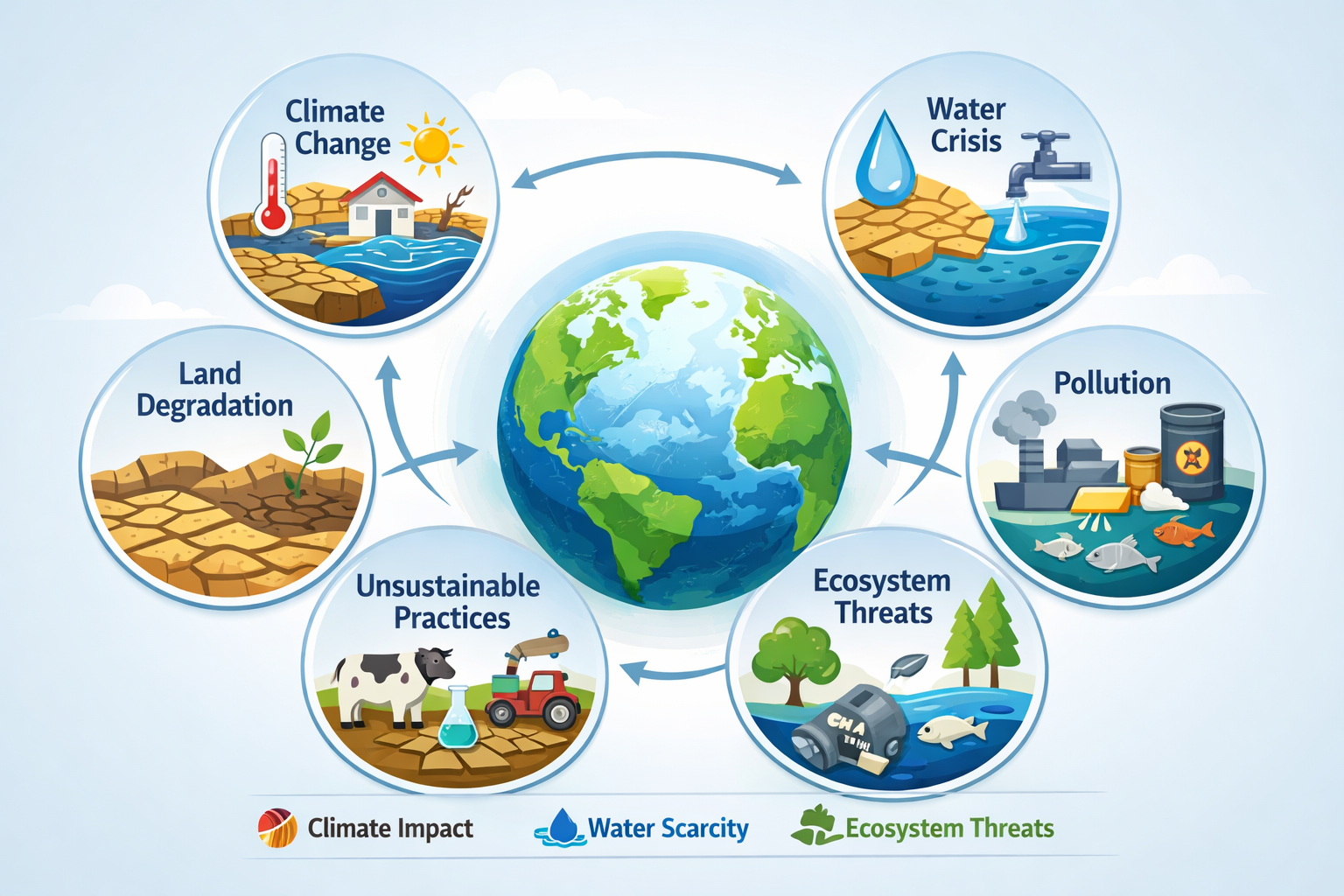
Global climate change is increasing temperatures, sea-level rise, and extreme events such as droughts, floods, and salinity intrusion. These changes directly affect ecosystems, agricultural production, and global food security.
Water availability is becoming increasingly unstable due to climate change and overexploitation, leading to freshwater scarcity in many regions. At the same time, salinity intrusion and declining water quality pose major challenges for sustainable water management.
Agricultural soils are increasingly degraded due to salinization, erosion, desertification, and declining organic matter. The shifting boundaries of ecosystems (saline – brackish – freshwater) further increase risks in land and water management.
Soil, water, and air pollution are intensifying due to the accumulation of agrochemicals, heavy metals, and waste. These issues pose significant threats to ecosystems and human health on a global scale.
Inefficient management of agricultural residues and natural resources, along with rising greenhouse gas emissions (CH₄, N₂O) from agriculture, exacerbates climate change. In addition, limited adoption of advanced technologies and weak linkages in agricultural value chains hinder progress toward sustainability.


ⓒ 2026 BICE | Biochar-based Integrated Circular Economy for Paddy Rice.

