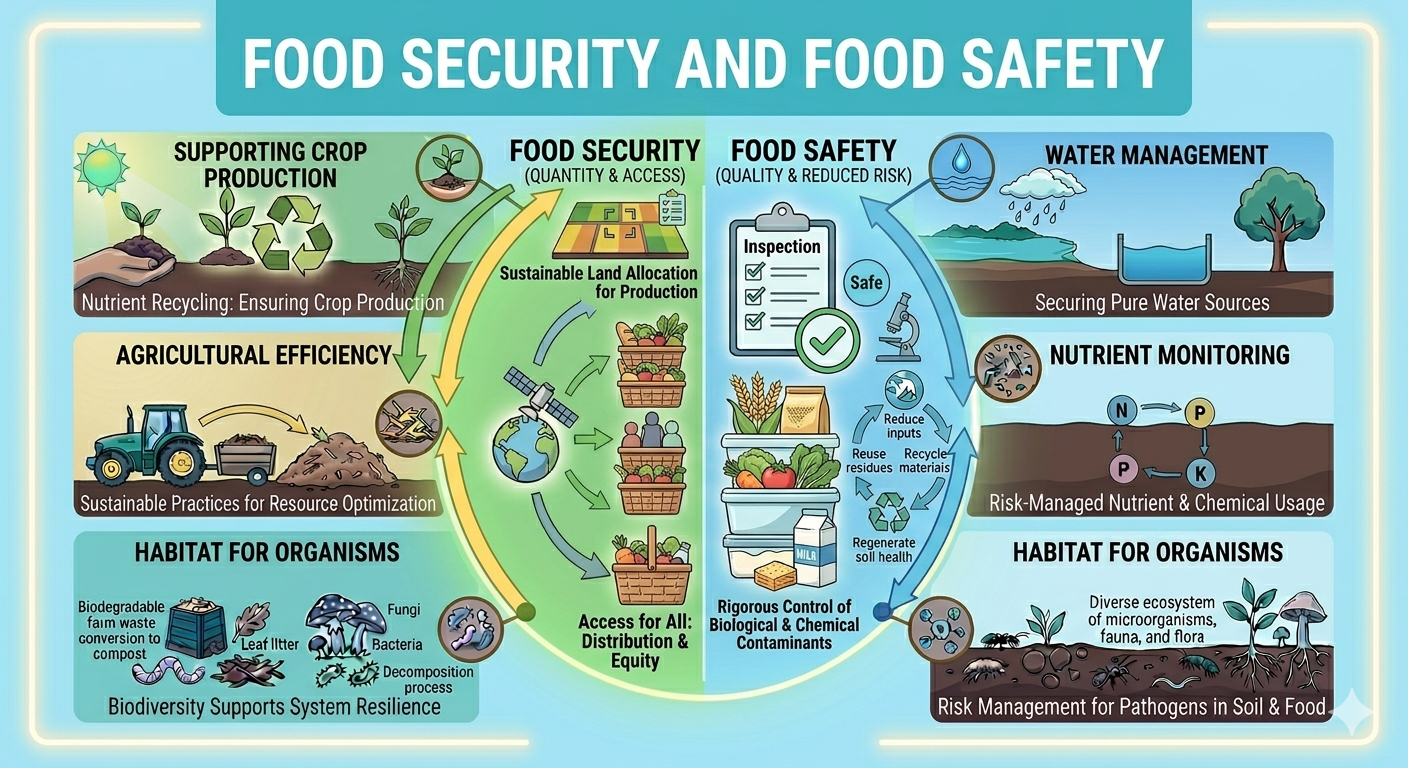
Challenges from a multi-layered food crisis
The world is currently confronting a severe crisis in food security and safety, driven by the synergistic impacts of climate change, resource degradation, and geopolitical conflicts. Empirical data indicate that in 2023, approximately 733 million people suffered from hunger, an increase of 152 million compared to 2019 (Ginzky et al., 2026). This crisis stems from three primary drivers: warfare, economic downturns, and climate change (Aljaafreh, 2026).
Among these, soil resources play a pivotal role but are under grave threat, with 40% of global arable land already degraded, affecting the livelihoods of 3.2 billion people. The decline in soil fertility not only diminishes crop yields and exacerbates greenhouse gas emissions but also acts as a catalyst for instability; in fact, roughly 40% of current transboundary disputes are linked to access to land and water resources.
Consequences of climate change and food safety risks
Climate change is disrupting traditional farming cycles and escalating hazardous biological risks. Extreme weather phenomena, such as storms, floods, and droughts in Asia and Africa, have altered pest and disease ecosystems, placing immense pressure on agricultural production (Aljaafreh, 2026). Notably, rising temperatures, particularly nocturnal temperatures, have led to outbreaks of Aflatoxin B1 (Guo et al., 2026). A study conducted in China warns that by 2100, the volume of peanuts contaminated with AFB1 exceeding safety thresholds could reach 1.16 million tons. This underscores that climate change not only causes quantitative shortages but also poses a direct threat to food quality and consumer health (Guo et al., 2026).
Solutions for sustainable agricultural system transformation
To ensure food stability for a population projected to reach 9.8 billion by 2050 and to achieve Sustainable Development Goal 2 (SDG 2-Zero Hunger), the global agricultural system requires systemic reform. Key priorities include the application of digital transformation, advancements in poultry production science, and a focus on soil health (Bustos-Terrones et al., 2026; Nassar, 2026). Beyond technical solutions, a multidimensional approach to legislation and policy is decisive. Nations must fulfill their obligations to respect human rights concerning adequate food and a healthy environment. Specifically, securing land tenure for women and marginalized groups is regarded as the cornerstone for social stability and sustainable agricultural development in the future.
Authors: Nhi Yen Thi Tran, Tung Xuan Tan Nguyen, Binh Thanh Nguyen*
References
Aljaafreh, O. M. (2026). The Impact of Sustainable Food Supply Chain on Food Security: Case Study of Jordanian Food Companies. International Journal of Agriculture and Biosciences, 15(2), 831-839. https://doi.org/10.47278/journal.ijab/2025.233
Bustos-Terrones, Y. A., Tariq, R., Rangel-Peraza, J. G., Torróntegui-Chávez, G., & Loaiza, J. G. (2026). Sustaining global food security through digitalization. In Climate Change Impacts on the Water-Energy-Food Nexus (pp. 289-302). Elsevier. https://doi.org/10.1016/B978-0-443-22320-4.00013-X
Guo, C., Zhao, Y., Liu, A., Wang, D., Wang, X., Yu, L., ... & Zhang, L. (2026). Dynamic changes and early warning of peanuts' aflatoxin B1 contamination in China in the context of climate change. npj Science of Food. https://doi.org/10.1038/s41538-025-00696-1
Ginzky, H., Grinlinton, D., Heuser, I. L., Kameri-Mbote, P., Khatibi, A., Rodriguez-Eugenio, N., & Ruppel, O. C. (2026). International Yearbook of Soil Law and Policy 2025 (p. 540). Springer Nature. https://doi.org/10.1007/978-3-032-03251-5_7
Nassar, F. S. (2026). Strategic role of poultry production sciences in shaping the future of global food security and strengthening sustainability. Poultry Science, 106617. https://doi.org/10.1016/j.psj.2026.106617


ⓒ 2026 Nhóm nghiên cứu Tài nguyên và Môi trường bền vững.

