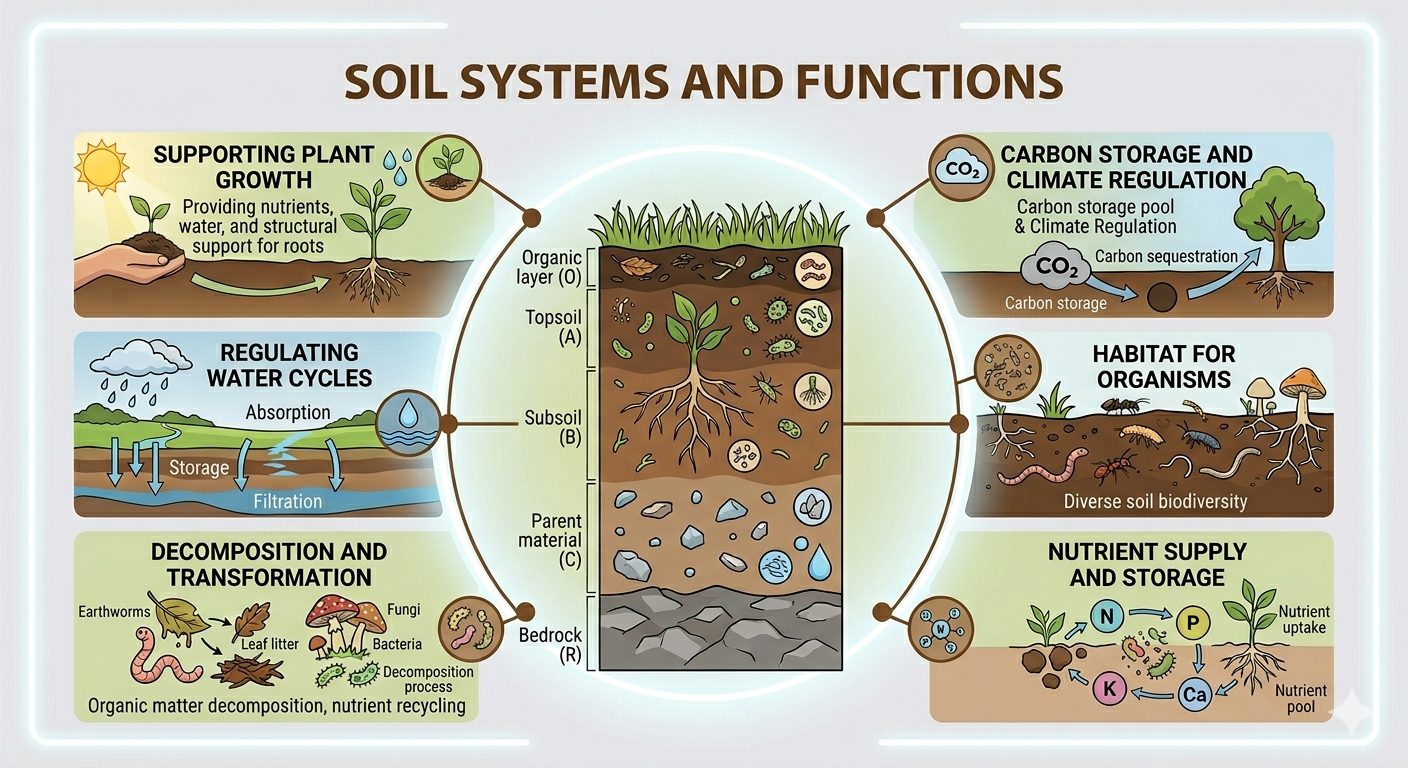
Soil systems are defined as complex ecosystems in which interactions among mineral components, organic matter, water, air, and soil biota generate fundamental ecological functions. Soil functions include biomass production, nutrient cycling, water regulation, carbon storage, and the maintenance of biodiversity (Kopittke et al., 2025). Through these processes, soils provide essential ecosystem services such as food security, water filtration, climate regulation, and support for human livelihoods (Pereira et al., 2018).
In the global context, soil systems are increasingly under pressure from climate change and anthropogenic activities. Land degradation is occurring at a large scale through physical, chemical, and biological processes such as erosion, compaction, organic matter depletion, and biodiversity loss (Dessureault-Rompré, 2022). It is estimated that approximately 12 million hectares of agricultural land are degraded annually, significantly reducing soil functionality (Dessureault-Rompré, 2022). At the same time, the role of soils in climate change mitigation is increasingly emphasized, particularly for their capacity to sequester carbon and regulate biogeochemical cycles (Delgado-Baquerizo et al., 2025).
In Vietnam, soil systems are strongly influenced by intensive agriculture, land-use change, and urbanization. Key challenges include soil degradation in cultivated lands, salinization, and the decline of soil organic matter, particularly in coastal plains and upland sloping areas. Nevertheless, Vietnam is promoting sustainable soil management approaches such as agroecology, conservation agriculture, and soil function restoration to enhance resilience to climate change.
In the future, soil system research should shift from a single-discipline approach to an interdisciplinary framework that integrates soil science, ecology, and data science. The evaluation and management of soils based on their functions and ecosystem services will provide a scientific foundation for sustainable development and global environmental security.
Authors: Tung Xuan Tan Nguyen, Binh Thanh Nguyen*
References
Delgado-Baquerizo, M., Eldridge, D. J., Liu, Y.-R., Liu, Z.-W., Coleine, C., & Trivedi, P. (2025). Soil biodiversity and function under global change. PLoS Biology, 23(3). https://doi.org/10.1371/journal.pbio.3003093
Dessureault-Rompré, J. (2022). Restoring Soil Functions and Agroecosystem Services Through Phytotechnologies. Frontiers in Soil Science, 2. https://doi.org/10.3389/fsoil.2022.927148
Kopittke, P. M., Harper, S. M., Asio, L. G., Asio, V. B., Batalon, J. T., Batuigas, A. M. T.,…Sanchez, P. B. (2025). Soil degradation: An integrated model of the causes and drivers. International Soil and Water Conservation Research, 13(4), 744-755. https://doi.org/10.1016/j.iswcr.2025.07.010
Pereira, P., Bogunovic, g., Muñoz-Rojas, M., & Brevik, E. C. (2018). Soil ecosystem services, sustainability, valuation and management. Current Opinion in Environmental Science & Health, 5, 7-13. https://doi.org/10.1016/j.coesh.2017.12.003


ⓒ 2026 BICE | Biochar-based Integrated Circular Economy for Paddy Rice.

