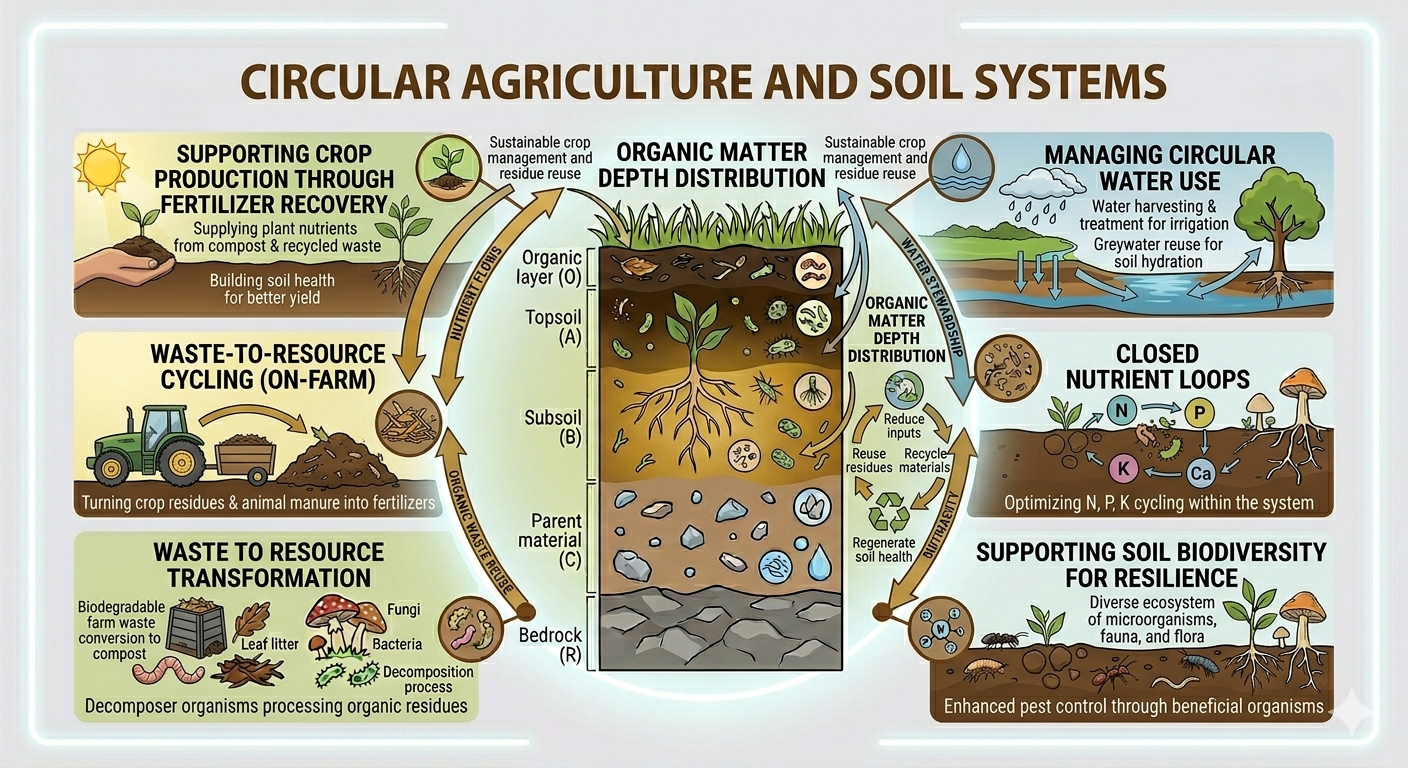
Circular agriculture is increasingly recognized as an important approach in modern agricultural systems, in which material flows are organized in closed-loop models to reduce external inputs, minimize waste, and recycle by-products back into the production cycle. The FAO emphasizes that circular agriculture can reduce nutrient losses, limit wastewater and surface runoff, while UN/DESA highlights that crop diversification and integrated crop livestock systems help manage soil fertility, reduce dependence on chemical fertilizers, and enhance the resilience of farming systems (FAO, 2026; UN/DESA, 2021).
From a soil science perspective, soil is the foundation of the circular economy as it performs essential functions in storing, filtering, and transforming water, carbon, and nitrogen; therefore, soil health directly determines the capacity for biomass recycling and the maintenance of nutrient balance within agroecosystems. From this standpoint, sustainable soil management is not only a resource conservation measure but also a prerequisite for the effective and long-term functioning of circular agricultural systems (Breure et al., 2018).
Globally, and particularly in Vietnam, agriculture generates large volumes of residues and waste from rice production, aquaculture, fruit cultivation, and livestock systems; these material streams can be valorized into organic fertilizers, biofertilizers, and energy, thereby improving soil quality and reducing environmental pressure. In the transition toward sustainable agricultural systems, circular agriculture should be positioned as a central pillar in soil and nutrient resource management. Integrating biological material flows into the soil cycle not only enhances soil fertility and health but also reduces emissions and improves resource use efficiency. Promoting circular agriculture in conjunction with science-based soil system management will be a strategic pathway to ensure food security, environmental protection, and effective climate change adaptation in the long term.
Authors: Tung Xuan Tan Nguyen, Binh Thanh Nguyen*
References
Breure, A. M., Lijzen, J. P. A., & Maring, L. (2018). Soil and land management in a circular economy. Science of The Total Environment, 15(624), 1125-1130. https://doi.org/10.1016/j.scitotenv.2017.12.137
FAO. (2026). Circular Economy: Waste-to-Resource. https://www.fao.org/land-water/overview/onehealth/circular/en/
UN/DESA. (2021). Circular agriculture for sustainable rural development. https://desapublications.un.org/policy-briefs/undesa-policy-brief-105-circular-agriculture-sustainable-rural-development


ⓒ 2026 BICE | Biochar-based Integrated Circular Economy for Paddy Rice.

