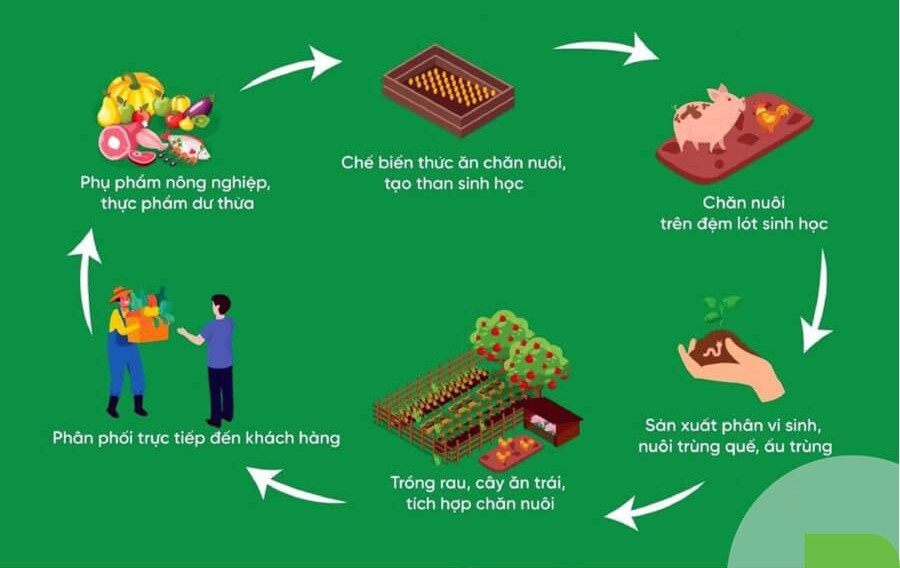
Circular agriculture is increasingly regarded as a vital strategy to address the global resource crisis. This model focuses on closing nutrient loops: waste from one process becomes input for another, forming a zero-waste production cycle. Utilizing crop residues as organic fertilizers helps reduce dependence on chemical fertilizers while significantly improving soil structure and enhancing long-term water retention capacity. Understanding biological cycles is essential for designing sustainable production systems. Beyond reducing production costs, this model also lowers greenhouse gas emissions and protects the environment from harmful pollutants. Recent studies have demonstrated that integrating circular crop–livestock–aquaculture systems significantly increases the added value of agricultural products compared to conventional intensive farming methods.
Circular agriculture is not only about economic efficiency but also serves as a solution for protecting agroecosystems under environmental pressures. Optimizing material cycles, it helps maintain soil fertility and minimizes water pollution caused by chemical fertilizer residues. With this approach, farmers can become more self-sufficient in input supplies, thereby reducing risks associated with price fluctuations in international markets. Transitioning to circular agriculture also enhances the resilience of production systems to adverse climate change. This is a promising pathway that supports the transformation of agriculture from a polluting system to a sustainable bioeconomy, where food production is no longer a burden on the planet but becomes part of nature restoration (Jaroenkietkajorn et al., 2024).
Authors: Hao Phu Dong, Binh Thanh Nguyen*
References:
Jaroenkietkajorn, U., Gheewala, S. H., Mungkung, R., Jakrawatana, N., Silalertruksa, T., Lecksiwilai, N.,…Nilsalab, P. (2024). Challenges and opportunities of bio-circular-green economy for agriculture. Circular economy and sustainability, 4(3), 1729-1750.